

American Czestochowa Shrine highlights U.S. history
‘A monument to freedom’ extends special welcome to visitors
as America celebrates its 250th anniversary
The National Shrine of Our Lady of Czestochowa, founded as “a monument to freedom” in the words of one U.S. president, welcomes all visitors to experience American, Polish-American and Catholic history through art, monuments and daily opportunities for prayer during the celebration of the nation’s 250th anniversary.
“Reverence for Our Lady draws many to our Shrine, and many others are drawn to our beautiful campus on Beacon Hill overlooking the countryside and our historical and religious monuments and sculptures, or to simply find a quiet place to pray,” said Father Provincial Krzysztof Wieliczko. “All are welcome.”
American Czestochowa invites all to a week of prayer for the United States June 28-July 4 (details here).
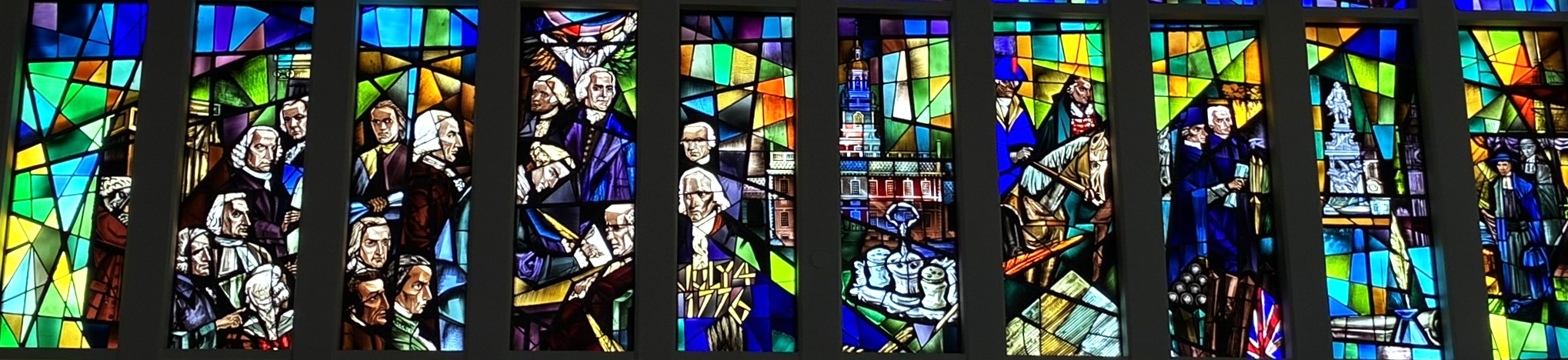
Visitors to American Czestochowa can read the history of America and the growth of Catholicism in the New World in the 70 panels of stained glass that adorn one wall of the main church. On the opposite wall, a similar installation depicts the history of Poland. At the façade of the church, 50 panels tell the history of the Catholic faith.
On the American side of the stained-glass installation, midway between floor and ceiling and viewing left to right, is a panorama of early U.S. history and symbols. Images of the Liberty Bell, Betsy Ross flag, a marching drum and an eagle underline key figures in the American Revolutionary War above them.
Pictured are members of the Continental Congress signing the Declaration of Independence, commemorated on July 4, 1776. An inkstand and Philadelphia’s Independence Hall are also depicted.
In the next two panels on the right are four central figures in the American Revolution. George Washington is astride a horse with Casimir Pulaski, the “Father of the American Calvary,” next to him. Thaddeus Kosciuszko, who designed fortifications for the defense of West Point, stands with his friend, Thomas Jefferson. Pulaski and Kosciuszko had fought for Polish independence. Pulaski, a hero of the Battle at Chadd’s Ford, was mortally wounded in battle at Savannah, GA.
Several hundred Poles fought for U.S. independence during the American Revolution.
Among other American history scenes depicted in stained glass:
- The discovery of America
- Arrival of the first Polish settlers in Jamestown (1607)
- Our Lady of Guadalupe, Patroness of the Americans, just above the American Revolution panorama
- The first Native American saint, Kateri Tekakwitha, and first native born American saint, Elizabeth Ann Seton, among others. Relics of these saints and many others since the founding of the Catholic Church can be venerated in the lower church at the Shrine, the Chapel of Our Lady of Czestochowa.
- And many other scenes told in 34 stained glass images on the American side, culminating with the dedication of the Shrine in 1966. One thousand years of Polish history are told in 36 images on the opposite wall.
Throughout its 71 years, American Czestochowa is an enduring destination for humble pilgrims and world leaders.
President Lyndon Johnson called the Shrine “a monument to freedom” at its dedication ceremony, and admirably described the significance of Polish immigrants who enriched America throughout its history.
Karol Cardinal Wojtyla, who became Pope John Paul II two years later, last visited in 1976 for the International Eucharistic Congress occurring the same year as the U.S. bicentennial. The saint’s visits to American Czestochowa are commemorated in a monumental sculpture between the main church and Visitor’s Center, and a museum with an eclectic collection of Pope St. John Paul II artifacts.
President Ronald Reagan commented on the friendship and trust between Poland and the U.S. when he visited during the Polish American Festival in 1984. A statue depicts him tasting pierogi commemorates the event.
An authentic reproduction of the miraculous icon of Our Lady of Czestochowa – touched to the original in Jasna Gora, Poland where it is enshrined for the last seven centuries – is embedded in a monumental bas relief of the Holy Trinity of the iconic sanctuary of the main church. It is the first and often most memorable sight a pilgrim encounters upon entering. Learning the history of this image of Our Lady (by tradition, said to have been painted by St. Luke), is itself a reason for pilgrimage to the national shrine.
Located in Central Bucks County, American Czestochowa is situated between New York and Philadelphia, and near major Revolutionary War sites such as Washington Crossing, Moland House in Warminster (where Washington and Pulaski met), and museums dedicated to local history and the American Revolution.